

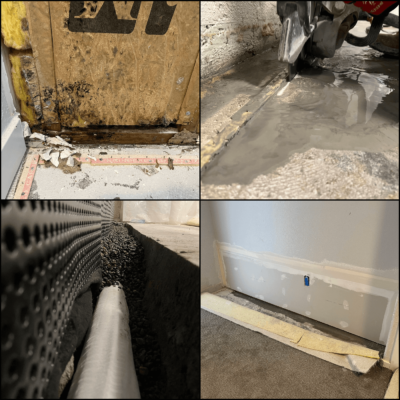
 Basement Expert installs interior basement waterproofing in Seattle-area homes when water comes through the walls or the floor joint and digging outside isn’t practical. If the yard side is open and the wall itself is failing, compare it with exterior basement waterproofing. Call (206) 388-7867 to set up an inspection. The basement is a full-fledged room in a residential building or any other property, but few owners use it completely due to the risk of water accumulation. Our waterproofing of basement walls and floor from the inside allows you to rationally use this space without any risk of negative consequences for the owner. Contact us today to learn more.
Holding Back Water at Rainy-Season Pressure
- Our inside basement waterproofing system eliminates the risk of water penetration and accumulation in the basement of a residential building, even during the rainy season, when foundations and other supporting structures are subjected to increased hydrostatic pressure.
- After the installation of this system, mold will not form in the room, bacteria and insects will not multiply.
- A comfortable microclimate will always be maintained in the basement, which will make it possible to use it for its intended purpose.
- In a dark, dry basement, it is ideal to set up a home theater without fear of electronic equipment that can get damp.
- The interior decoration components will last longer and the owner won’t have to keep making repairs if there isn’t any moisture on the walls and floor of the basement.
- Waterproofing is also additional mechanical protection, which prevents rapid destruction and helps to avoid major repairs of the foundation.
- We recommend our basement waterproofing system for your residential or commercial building.
Why Homeowners Choose the Inside Route
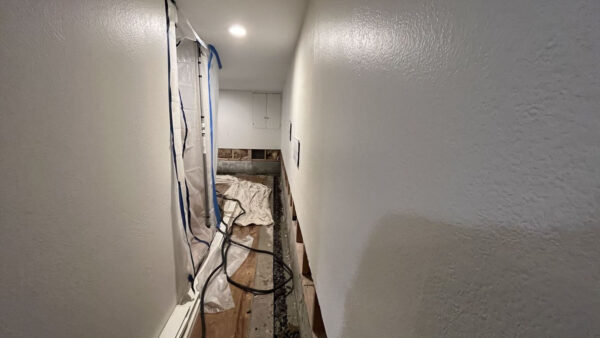
- Since there will no longer be obstacles in the form of backfilling of the excavation sinuses to prevent access to the basement walls, the technology of sealing basement walls from the inside with a membrane can be installed at any stage of building construction.
- The innovative technology of waterproofing basement walls from the inside eliminates the risk of building structure leakage caused by poor-quality seams between piece stone materials.
- The performance of covering concrete basement walls with a membrane from the inside ensures long-term preservation of both the materials of the supporting structures themselves and all elements of the final decorative finish.
- The indoor climate is significantly improved, which allows it to be used for any purpose, including the organization of a second living room, a home theater, or a pantry for storing canned food.
- Waterproofing basement walls from the inside costs less than from the outside.
- It is not necessary to wait for good weather to perform these works on the interior of the premises, because waterproofing can be performed even during the cold season or during heavy rains, provided that the surface of building structures can be dried.
Inside the Basement: Prep, Seal, and Drain
Works on internal basement waterproofing are carried out by our specialists, strictly in compliance with the project, and regulatory requirements, as well as the following flow chart:
- The old wall and floor covering have been completely removed down to the concrete foundation.
- All cracks, as well as points where leakage or dampness of the walls is visible, as well as joints between blocks, are grooved or deepened by at least 15 mm using a drill.
- To open up all pores and microcracks, the entire surface is processed using an angle grinder and a medium-hard brush nozzle.
- A deep penetration primer or penetrating waterproofing is used. You can proceed to the next steps only after you have waited the time specified in the tool’s instructions.
- Cement waterproofing mixtures are used to fill grooves, joints between blocks, and prepared holes. For a high-quality setting of the solution, it is often necessary to soak the solution in water for two to three days.
- The primary waterproofing layer must be applied as the final step. It could be liquid rubber, polymer membrane, coating mastic, or roofing material. Such work will result in the construction of a complete obstruction to groundwater.
Call us today to learn more about the process or to schedule a free basement interior waterproofing consultation.
Pricing a Job With No Trench
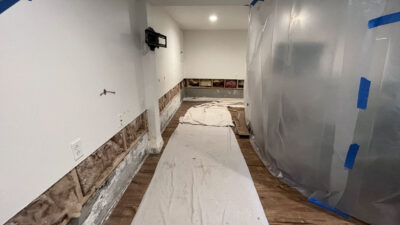 Many owners of private houses, offices, or commercial buildings with basements, when contacting our company, ask what is the average cost of interior basement waterproofing. Our basement waterproofing system costs from $50 to $300 per linear foot on a turnkey basis around Seattle.
However, we will not be able to offer an exact price right away over the phone, since our inspector will need to visit the project and perform inspection first. After that, we will be able to calculate an estimated price for the project. Our inspections and estimates are completely free; call (206) 388-7867 to schedule one.
The final price of our work depends on factors such as the amount of water entering the building, the hydrostatic pressure of ground or stormwater during the period of flooding, the total area of the basement affected by water.
Thus, we provide only an individual approach to each customer, and don’t offer a base price to our customers. This allows us to provide the best customer service possible for our clients.
Which method is right for you?
Inside work makes sense when water enters at the floor joint or through block seams and the outside of the wall is hard to reach. If you are still deciding, read our breakdown of exterior vs interior basement waterproofing. Be wary of quick fixes, too: we cover interior gutters vs engineered waterproofing and damp-proofing vs waterproofing membranes. If the wall looks dry but the room still smells damp, read how moisture moves through solid concrete via capillary action and vapor pressure.
Before You Book an Inside Job
Below are answers to all the most frequently asked questions from our customers, which will greatly facilitate the work of new visitors to our website. Want to talk it through first? Call (206) 388-7867.
Interior basement waterproofing is a problem that cannot be solved by a do-it-yourself project. You need the help from highly experienced waterproofing experts. Consider calling our company if you have seen signs of water seeping, leaking, and/or mold in the lower layers of your home. We will assist you with a consultation and/or on-site inspection. We have the most up-to-date equipment, methodology, experience, and expertise to handle such issues in your area. Our specialists work all around the Seattle, Bellevue, and Everett, in the state of Washington.
Our Service Area
We provide interior basement waterproofing services in Seattle, WA and surrounding areas (98101–98119, 98121–98122, 98124–98127, 98129, 98131, 98133–98134, 98136, 98138–98139, 98141, 98144–98146, 98148, 98154–98155, 98158, 98160–98161, 98164–98166, 98168, 98170, 98174–98175, 98177–98178, 98181, 98185, 98188, 98190–98191, 98194–98195, 98198–98199).

