

Engineered Basement Flood Restoration & Structural Waterproofing
Immediate water extraction followed by NDS-certified structural solutions. We don’t just dry your floors; we engineer your foundation to eliminate the hydrostatic pressure that caused the failure.

⭐⭐⭐⭐⭐
5-Star Rated Company | Based On GMB Reviews
Insurance-ready!
Rapid Mitigation & Structural Drying with NDS-Certified Pros. Trusted by Seattle’s Businesses & Homeowners
When you’re standing in two inches of water, “eventually” isn’t an option. It is all about stopping the damage in its tracks and reclaiming control of the environment before the building’s skeleton begins to suffer.
High-Volume Water Extraction
We don’t show up with a shop-vac and a prayer. Our team deploys commercial-grade, truck-mounted extraction units designed to move massive volumes of water in minutes, not hours.
-
Stop the Clock: Rapid extraction prevents structural saturation, keeping moisture from “wicking” up into drywall and insulation.
-
Immediate Relief: We prioritize clearing standing water to stabilize the site and allow for a full damage assessment.
Psychrometric Monitoring & Drying
If a wall feels dry to the touch, it’s often a lie. We use psychrometric science—the study of air, moisture, and temperature—to ensure your property is dry at a molecular level.
-
Deep Extraction: We target hard-to-reach areas like masonry and sill plates, pulling moisture out of the materials that actually hold your building up.
-
Technical Precision: Using moisture thermography and hygrometers, we monitor vapor pressure to ensure we are meeting IICRC professional drying standards, not just “airing things out.”
Antimicrobial Sanitization
Floodwater is rarely just H2O; it’s a biological cocktail. Before the engineering or reconstruction phases begin, we ensure the space is clinically clean.
-
Pathogen Neutralization: We apply hospital-grade antimicrobial treatments to kill bacteria and viruses brought in by groundwater or sewage.
-
Mold Preemption: By treating surfaces immediately, we disrupt the mold growth cycle before it can colonize your structural Timbers or HVAC system.
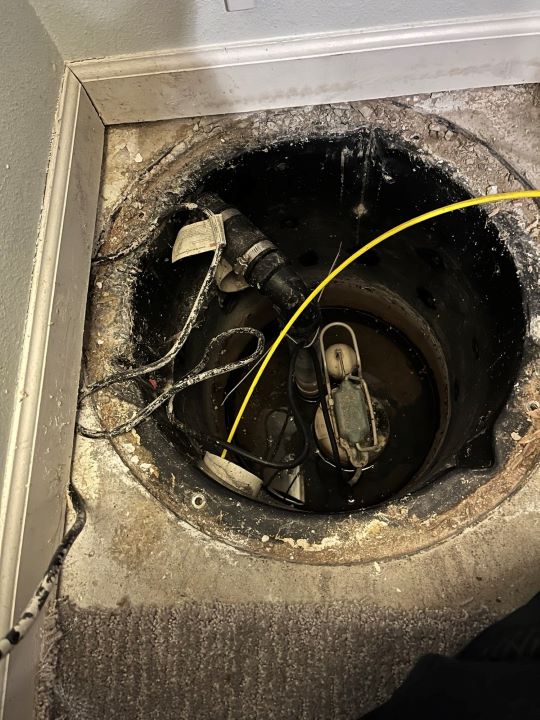
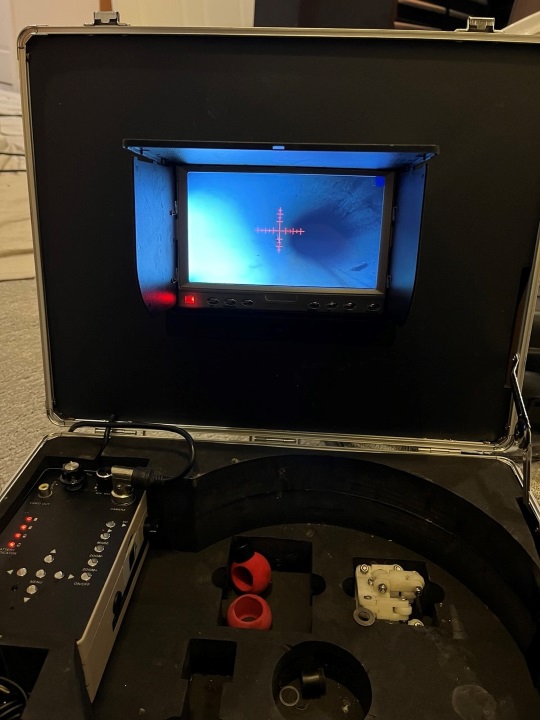
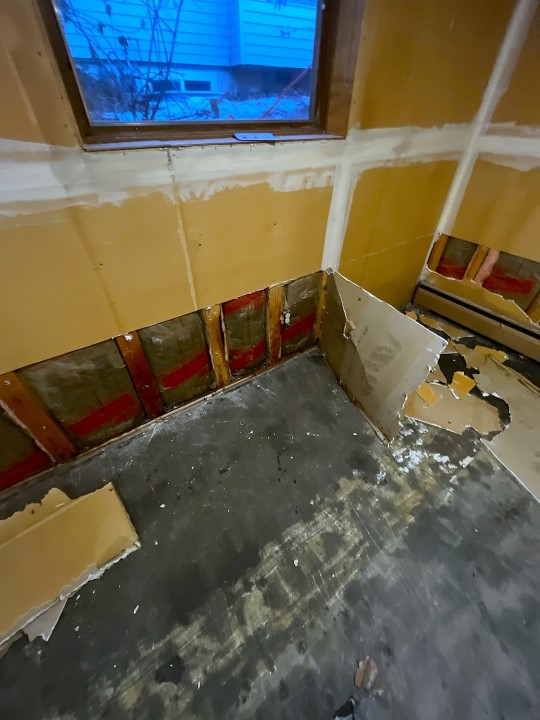
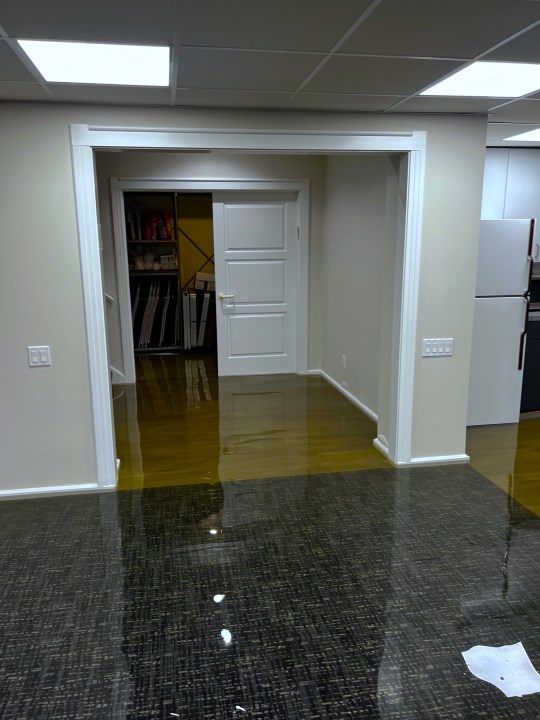
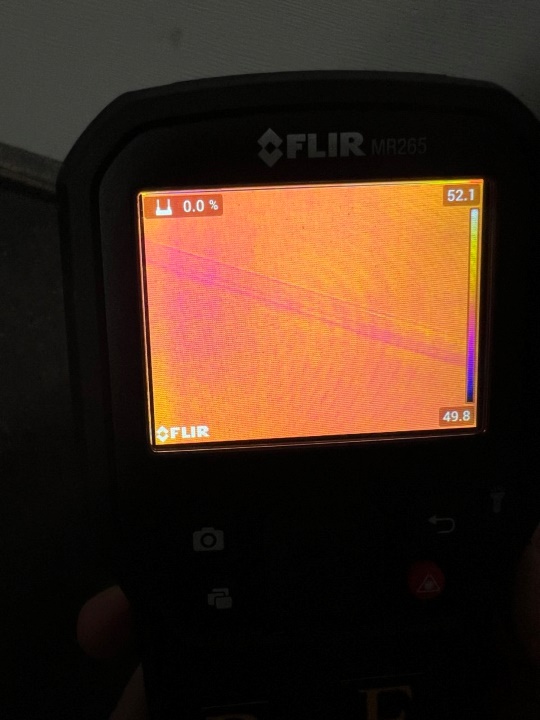
Insurance-ready
Claims-Grade Documentation:
We provide a comprehensive “Scope of Work” and moisture-mapping report designed for your adjuster. By documenting the exact source of failure and the physics of the intrusion, we provide the technical evidence needed to support your restoration claim.
Preventative Mitigation Logic:
Our reports don’t just cover the cleanup; they categorize the structural repair as “Active Mitigation.” This helps you demonstrate to your insurance carrier that the repair is a necessary step to prevent recurring high-cost flood claims.
Professional Line-Item Invoicing:
We move beyond “lump sum” estimates. Our detailed, line-itemed invoices follow industry-standard reporting, making it easier for your insurance company to review, approve, and reimburse your restoration costs.




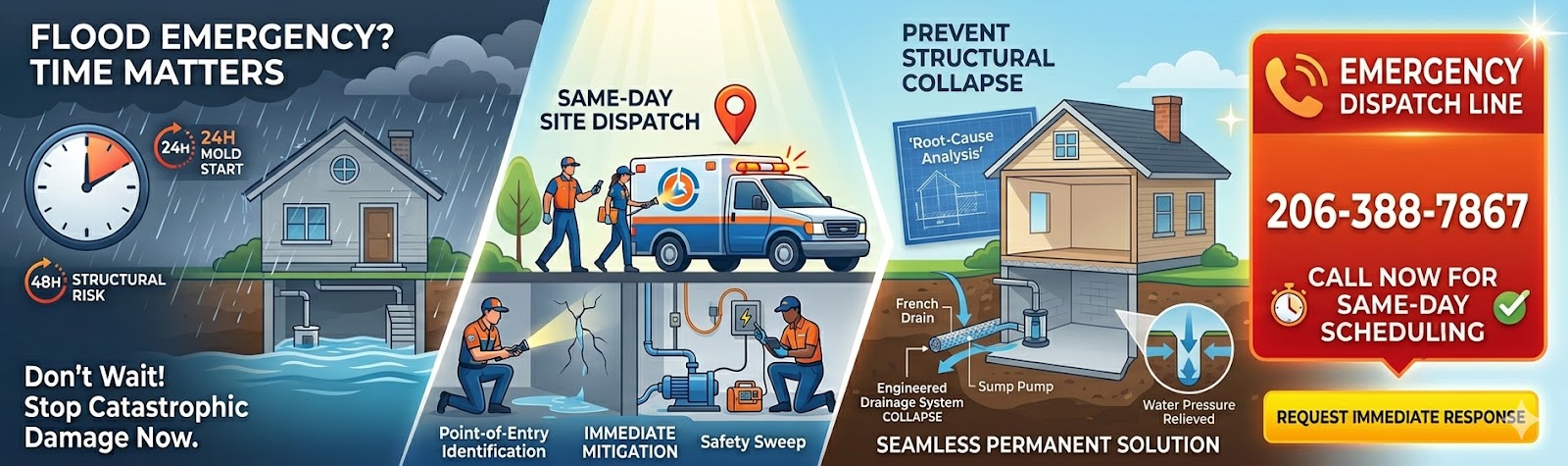
Rapid Response: Same-Day Emergency Flood Assessment
In a flooding event, every hour matters. Water doesn’t wait for business hours, and neither do we. We provide same-day scheduling to stop the damage before it becomes a structural catastrophe.
Immediate “Stop-Gap” Mitigation
When you call us for an emergency, our goal isn’t just to look at the water—it’s to stabilize the environment. While we focus on long-term engineering, our rapid-response team handles the immediate pressure:
-
Same-Day Site Dispatch: We prioritize active flooding calls to ensure a specialist is on-site within hours, not days.
-
Point-of-Entry Identification: Our first priority is finding exactly where the breach is occurring to implement immediate, temporary diversion or containment.
-
Electrical & Safety Sweep: We assess the safety of your basement, checking for submerged utilities or structural risks before any work begins.
Why “Waiting until Monday” is a Structural Risk
A basement that stays wet for 48 hours is no longer just a “cleanup” job; it becomes a biological and structural liability. Here is why we push for same-day action:
-
The 24-Hour Mold Window: Mold spores can begin colonizing organic materials (drywall, baseboards, sill plates) in as little as 24 to 48 hours.
-
Hydrostatic Saturation: The longer water sits against your foundation, the more the surrounding soil becomes “surcharged,” increasing the lateral pressure and the risk of wall deflection.
-
Capillary Action: Concrete is a sponge. Same-day response prevents water from “wicking” up several feet into your home’s framing and insulation.
Seamless Transition to Permanent Stabilization
Unlike standard restoration companies that dry the floor and leave, our emergency response is the first step of our Root-Cause Analysis. Once the immediate crisis is stabilized, we transition directly into designing the engineered diversion waterproofing system that ensures this is the last time you ever have to deal with a flood.
Immediate Action: If you are currently seeing active seepage or standing water, call our priority dispatch line now for same-day scheduling and professional mitigation.
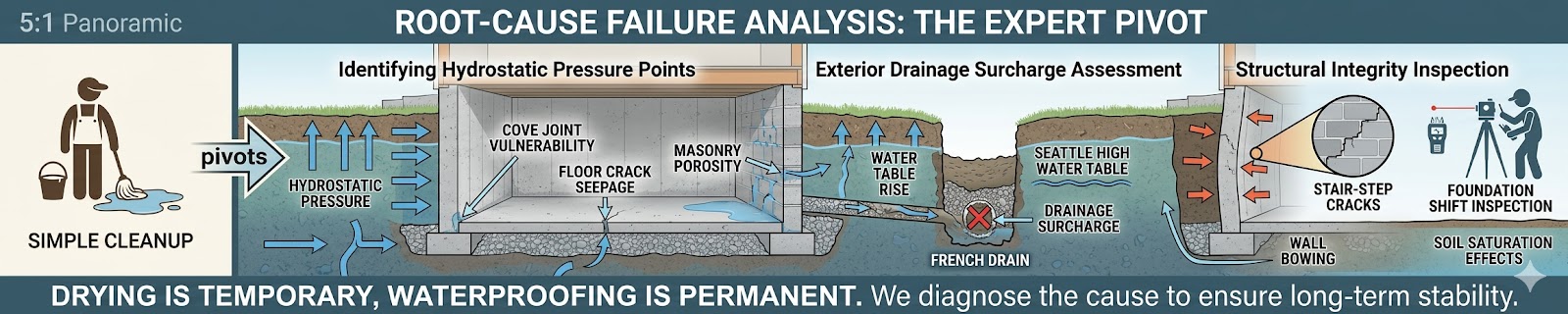
Root-Cause Failure Analysis: The Expert Pivot
Drying the floor is a temporary fix. Hardening the structure is a permanent solution. While “mop and bucket” crews focus on the symptoms, we diagnose the disease.
Identifying Hydrostatic Pressure Points
Water doesn’t just “leak” into a basement; it is often forced in by the sheer weight of the surrounding water table. Our analysis identifies the specific failure points where your home’s envelope has been breached:
-
Cove Joint Vulnerability: We inspect the critical junction where the floor slab meets the foundation wall—the most common point for pressure-driven seepage.
-
Floor Crack Dynamics: We determine if floor cracks are superficial or “active” channels being exploited by rising groundwater.
-
Masonry Porosity: Using moisture mapping, we detect if water is “wicking” through concrete blocks via capillary action, which can lead to long-term efflorescence and structural decay.
Exterior Drainage Surcharge Assessment
In the Pacific Northwest, our soils often reach a “surcharge” state where they can no longer absorb Seattle’s relentless rainfall. We look beyond your walls to find the external culprit:
-
French Drain Failures: We test perimeter drainage systems to see if they are crushed, silted-up, or simply overwhelmed by the volume of water.
-
High Water Table Logistics: We evaluate how local groundwater levels are interacting with your foundation, ensuring your pump system is actually rated for the “head pressure” it’s facing.
-
Surface Diversion: We analyze gutter outflows and landscape grading to ensure your yard isn’t inadvertently acting as a funnel toward your crawlspace or basement.
Structural Integrity Inspection
A flood is a weight event as much as a moisture event. Saturated soil exerts massive lateral pressure against your foundation. Our inspection looks for the “red flags” that appear after the water recedes:
-
Wall Bowing & Deflection: We check for inward curves in masonry walls caused by the weight of saturated earth.
-
Foundation Shifting: We look for “stair-step” cracking in mortar joints, which indicates the house is reacting to soil expansion or contraction.
-
Sill Plate & Joist Health: We verify that the wooden components of your home haven’t been compromised by the sudden humidity spike or direct immersion, preventing future dry rot.
The Specialist Difference: A standard restoration company asks, “How do we get the water out?” We ask, “Why did the earth decide to move into your basement in the first place?”
Engineered Prevention & Active Water Diversion: Moving from Defense to Offense
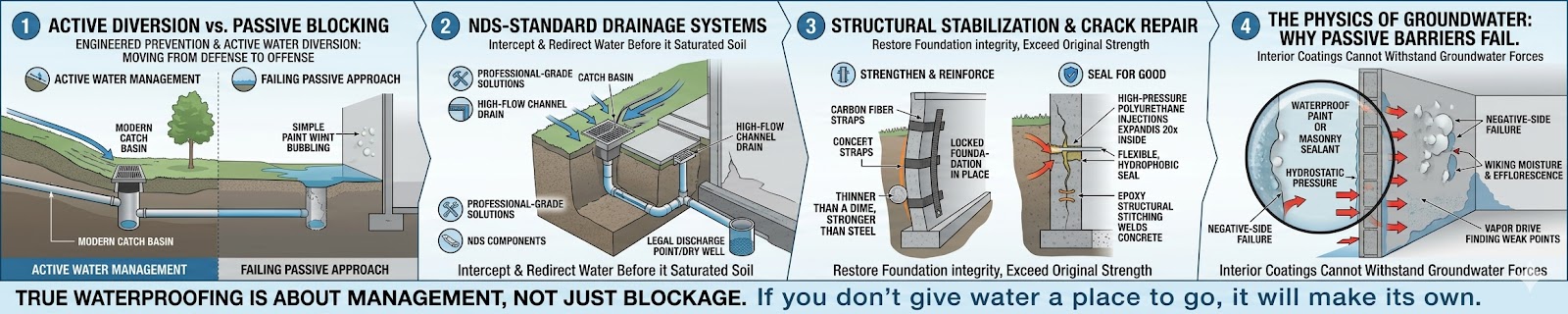
Stopping a flood starts long before the water reaches your basement. We replace “hope” with engineering, implementing systems designed to intercept, collect, and redirect water with surgical precision.
NDS-Standard Drainage Systems
We don’t just “dig a trench.” We design high-capacity diversion paths using NDS-standard (National Drainage Systems) components. These are the same professional-grade solutions used in commercial civil engineering to manage massive hydraulic loads.
-
Engineered Catch Basins: strategically placed to capture surface runoff before it can saturate the soil against your foundation.
-
High-Flow Channel Drains: Installed across driveways or walkways to create a “moat” effect, diverting sheet flow away from basement entryways.
-
Subsurface Discharge: We ensure water isn’t just moved a few feet away; it is piped to a legal discharge point or a dedicated dry well, preventing the “re-circulation” loop common in DIY installs.
Structural Stabilization & Crack Repair
A crack in your foundation is a structural vulnerability that water will eventually find. Our repair process doesn’t just “plug” the hole—it restores the wall’s original strength, and often exceeds it.
-
Carbon Fiber Reinforcement: For walls showing signs of bowing or lateral stress, we apply carbon fiber straps. These are thinner than a dime but stronger than steel, locking your foundation in place permanently.
-
High-Pressure Polyurethane Injections: Unlike hardware-store caulk, our industrial-grade resins expand to 20 times their volume, filling the entire void of a crack from the inside out to create a flexible, hydrophobic seal.
-
Epoxy Structural Stitching: For active structural cracks, we use high-tensile epoxy to “weld” the concrete back together, ensuring the foundation acts as a single, solid unit once again.
Why “Passive Barriers” and Sealing Often Fail
Many homeowners are sold on the idea of “waterproof paint” or interior masonry sealants. From a physics perspective, these are almost guaranteed to fail over time. Here is why:
-
The Physics of Hydrostatic Pressure: Groundwater exerts a staggering amount of force. A passive interior coating is trying to “hold back” thousands of pounds of pressure with a layer of film only a few millimeters thick. Eventually, the pressure causes the coating to bubble and peel (efflorescence).
-
Negative-Side vs. Positive-Side Waterproofing: Interior sealants are “negative-side” solutions. They don’t stop water from entering the wall; they just try to trap it inside the concrete. This leads to internal “wicking,” which can rot your sill plates and encourage mold growth behind finished walls.
-
The “Vapor Drive” Problem: Moisture is persistent. If you seal one spot without providing an active diversion path (like a sump or drain), the water will simply find the next weakest point in your foundation—usually a cove joint or a utility penetration.
The Expert Take: True waterproofing is about management, not just blockage. If you don’t give the water a place to go, it will eventually make its own.
The Path to a Sound Basement 5 Simple Steps
1. Hydrostatic Pressure Assessment
2. Immediate Mechanical Extraction
3. Active Diversion Implementation
4. Structural Stabilization & Drying
5. Post-Project Documentation & Warranty
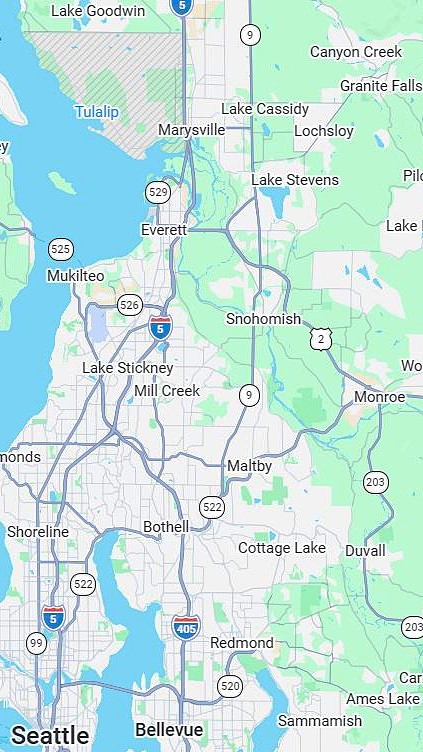
Basement Flood Restoration and Waterproofing in the Greater Seattle Area
Water doesn’t stop at the city limits, and neither does a rising water table. Due to the glacial till and relentless annual rainfall unique to the Pacific Northwest, homes from Seattle through Snohomish County face extreme hydrostatic pressure. We provide emergency flood restoration and permanent waterproofing systems across the following service areas:
-
Seattle: Serving all neighborhoods including Ballard, Capitol Hill, West Seattle, and Northgate. We specialize in stopping seepage in the porous brick and concrete foundations typical of Seattle’s historic homes.
-
Everett: Providing rapid flood mitigation in Silver Lake, View Ridge, and Lowell. We understand how Everett’s clay-heavy soils trap water against your foundation, leading to the “surcharge” that causes basement flooding.
-
Shoreline & Lake Forest Park: Addressing the complex drainage and runoff challenges created by the hilly terrain north of the city. We design diversion systems that keep gravity from sending the neighborhood’s runoff into your basement.
-
Edmonds & Lynnwood: Professional waterproofing and structural drying for mid-century and modern foundations. We replace failing original drains with engineered, high-capacity systems.
-
Bothell & Mill Creek: High-performance interior drainage and sump pump solutions for residential foundations across the Snohomish-King County line.
Not sure if we cover your neighborhood? Contact us today to discuss your structural needs in the Greater Seattle area.
1. Why did my basement flood if I have a “sealed” foundation?
Most foundation “sealants” are passive barriers—essentially just thick paint. While they may stop vapor, they cannot withstand the mechanical force of groundwater. Water is relentless; it will find the path of least resistance, which is typically the cove joint (where the wall meets the floor) or existing structural cracks. When external pressure exceeds the tensile strength of a topical sealant, the barrier fails. True protection requires an active water diversion system that relieves pressure rather than just trying to “block” it.
2. What is hydrostatic pressure and how does it affect Seattle homes?
Hydrostatic pressure is the force exerted by stagnant water against your foundation. In the Seattle area, our soil is often composed of dense glacial till and clay layers that do not drain quickly during atmospheric river events. As the soil becomes saturated, the weight of the water—roughly 62.4 pounds per cubic foot—pushes against your basement walls and upward against the floor slab. This pressure is what forces water through “invisible” masonry pores and hairline cracks.
3. Does insurance cover the “root cause” or just the cleanup?
Standard homeowner policies typically cover “sudden and accidental” water discharge (like a burst pipe), but they often exclude “seepage” or “groundwater intrusion” unless you have a specific flood rider. Insurance generally pays for the mitigation (extraction and drying) but considers the installation of a permanent drainage system a “home improvement” or “maintenance” issue. We provide detailed technical reports that help your adjuster clearly distinguish between the immediate damage and the structural failures involved.
4. How do NDS-certified systems differ from standard hardware-store fixes?
Hardware-store solutions are often “one-size-fits-all” and fail to account for site-specific soil mechanics or flow velocity. An NDS-certified (National Drainage Systems) approach involves calculated engineering. We analyze the catchment area and discharge capacity to ensure the system can handle peak-flow events. This includes using professional-grade basin filtrations, proper pipe bedding to prevent sedimentation, and ensuring the discharge lines are engineered to move water far beyond the foundation’s “zone of influence.”
5. What are the signs of a structural failure after a flood?
A flood is often a symptom of an underlying structural issue, or it can become the cause of one. Key signs of failure include:
-
Stair-step cracking in block walls.
-
Horizontal shearing or bowing of the foundation walls (often caused by the sheer weight of saturated soil).
-
Sill plate shifting, where the wooden frame of the house meets the concrete.
-
Efflorescence (white, powdery salt deposits), which indicates long-term moisture transport through the concrete.
6. How long does a professional structural dry-out take?
A proper dry-out is a scientific process called psychrometrics, not just “running some fans.” Depending on the porosity of your masonry and the level of saturation, a professional structural dry-out typically takes between 72 and 120 hours. We monitor “dry standards”—comparing the moisture content of affected materials against “dry” counterparts in the home—to ensure that deep-seated moisture in studs and sill plates is fully removed before any reconstruction or structural reinforcement begins.
Seattle’s Full-Spectrum Basement Flood & Water Damage Restoration Service
When you have water in the basement, you don’t just need a cleaning crew; you need a restoration company for water damage that understands the structural physics of your home. Whether you are dealing with water in the basement after heavy rain or a sudden pipe failure, our same-day service team is the best water damage restoration near me for homeowners who value engineered solutions over temporary fixes.
Same-Day Water Extraction & Flood Cleanup Services
If your basement floods when it rains, the clock is ticking. Our emergency water damage cleanup team provides flooded basement water removal using industrial-grade pumps to get water out of the basement and prevent long-term saturation. We offer:
-
Same-day basement flooding service and rapid flood restoration.
-
Technical sewage cleanup in basement for hazardous backups.
-
Flooded carpet drying and water damage carpet cleaning to salvage your interior finishes.
-
Basement water cleanup near me using high-capacity dehumidification.
Strategic Water Damage Repair & Basement Restoration
A flooded basement cleanup is only the first step. As restoration water damage experts, we handle the entire home water damage repair process. Unlike generic flood restoration companies, we specialize in basement water damage repair that addresses the root cause. From basement flooding repair to wet carpet in basement remediation, our water damage restoration service includes:
-
Comprehensive flood remediation and water leak restoration.
-
Basement restoration water damage assessments to check for structural shifts.
-
Water damage and restoration of drywall, baseboards, and sill plates.
-
Transparent water damage restoration cost and flooded basement repair cost estimates.
Why We Are the Top-Rated Flood Cleanup Company Near Me
Searching for flood restoration services can be overwhelming. We differentiate ourselves from high-volume franchises like Servpro basement cleaning by providing a dedicated contractor to repair water damage with over 6 years of Seattle-specific experience. Whether you need residential water damage restoration, fire and water damage restoration companies near me, or specialized basement refinishing near me after a disaster, we provide the best water restoration companies near me results with a focus on NDS engineering.
Professional Support for “My Basement Flooded” Scenarios
Don’t let water flooding in basement destroy your home’s value. Our water damage repair company offers specialized flood water removal services and water damage cleaning services designed for the Pacific Northwest climate. We are the flooded basement cleaning service that Seattle homeowners trust for emergency water cleanup near me and long-term basement restoration near me.

