

Foundation Crack Repair in Everett, WA | Inspection-First Wall & Slab Crack Diagnostics
From hairline fractures to leaking basement walls, we start with crack mapping and movement/water evidence—then recommend epoxy or polyurethane injection when it fits the crack type and goal, plus reinforcement when progressive movement is present.



Crack mapping + movement/water evidence review (inspection-first)
Epoxy/polyurethane injection when appropriate for the crack type and goal
Reinforcement and stabilization options when walls are moving or cracking progressively
Coordinate drainage and discharge improvements when hydrostatic pressure is part of the failure mode
Licensed foundation and waterproofing contractor serving Everett, Snohomish County, and the broader Puget Sound (Basement Expert / Artbrick LLC). Public Works–trained execution and manufacturer-aligned drainage detailing where drainage work is part of the repair scope.
Foundation crack repair for Everett-area homes: built on diagnostics
Cracks tell different stories depending on pattern, location, age, and whether water is actively moving through the assembly. In Snohomish County’s wet-season cycles, hydrostatic pressure and drainage behavior often accelerate deterioration—even when a crack first looks minor—so we start with mapping plus moisture and movement evidence, then narrow repair options based on what your foundation is actually doing.
In Everett and nearby Snohomish County neighborhoods, basement assemblies often span multiple eras—from older poured-wall basements and retrofitted crawl conversions to newer subdivision slabs—which can change how cracks present and where moisture first shows up against waterproofing boundaries and finishes.
Some cracks call for injection-focused repairs, while others require stabilization when progressive movement is present. When the right scope goes beyond localized crack treatment into broader stabilization planning, we align recommendations with our foundation repair hub so the approach stays coherent end-to-end.
We:
- Document what we observed (photos/measurements), what it implies, and what we recommend next
- Explain injection vs reinforcement pathways in plain English—matched to observed behavior
- Coordinate drainage/discharge improvements when water loading is part of the crack mechanism

Customer reviews (Puget Sound foundation work)
We’re proud of the reputation we’ve earned on real Puget Sound projects—including Everett and Snohomish County. If you want unfiltered feedback, start here: Basement Expert — Google reviews


When a foundation crack should trigger a professional evaluation
Not every hairline crack is an emergency—but some patterns should be evaluated promptly.
- Horizontal cracks / inward lean: can indicate bowing and lateral load issues (often hydrostatic-related in basements).
- Cracks wider than ~¼ inch (especially widening over time): can signal active movement—worth documenting and measuring.
- Sticking doors/windows across multiple openings: can indicate racking/settlement patterns (needs context, but don’t ignore progression).
- Stairstep cracking in brick veneer: often associated with settlement patterns—evaluate whether it’s tracking with movement.
If you’re unsure whether a crack is “monitor vs repair now,” the fastest path is an inspection. For broader stabilization beyond localized crack treatment, see our foundation repair hub.
Foundation crack repair process (Everett area)
1. On-site crack inspection & documentation
We map crack patterns, note locations (walls/slab/joints), and capture moisture/movement clues so recommendations are tied to what we can observe—not assumptions. Where suburban setbacks concentrate gutter/downspout discharge near the wall and those cues relate to what we’re seeing at the crack, we document them alongside crack geometry.
2. Written scope + estimate
After inspection, you receive a clear written scope with repair class options (injection vs stabilization pathways) and pricing aligned to the verified conditions.
3. Scheduling & pre-work walkthrough
We schedule work around access constraints, protection of finished spaces, and dust control expectations—so the job sequence is predictable before we start.
4. Repair execution + quality checks
Repairs are executed to the agreed scope (e.g., injection protocols when appropriate, reinforcement when movement warrants it), with checkpoints before concealment/finishing steps.
5. Closeout documentation
You receive closeout notes relevant to your project (photos/scope summary as applicable) and warranty/program details as written for your specific repair.
Why foundation cracks deserve a clear diagnosis
Cracks are common in Everett-area and Snohomish County homes, but “common” isn’t the same as “safe to ignore indefinitely.” The goal of an inspection is to separate stable, monitorable conditions from patterns that can accelerate with moisture, soil movement, or progressive wall behavior.
- Moisture pathways: even narrow cracks can admit water that drives spalling, reinforcement corrosion, and interior damage over time.
- Progressive movement: widening cracks, racking openings, or changing patterns usually mean you should document and act, not wait.
- Resale + risk: buyers and inspectors flag foundation symptoms fast—clear documentation matters if you’re planning to sell.
- Pest + air quality: openings can admit pests and damp soil air—often secondary, but real.
If you’re seeing new cracking, widening, leakage, or movement symptoms, schedule an inspection so you’re not guessing. We’ll explain what we think is happening, what we’d monitor vs repair, and what the next step looks like for your foundation.
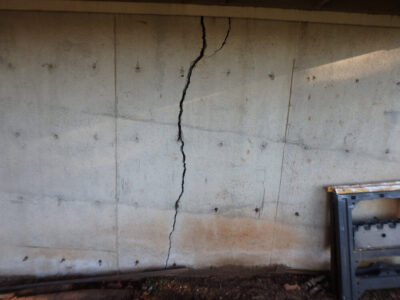
Common causes of foundation cracks: Everett / Snohomish County / Puget Sound
Foundation cracks are usually multi-factor: soil behavior, water, loads, and sometimes construction details interact—especially in wet PNW cycles.
On many Everett-area suburban lots, gutter and downspout discharge paths plus tight setbacks can concentrate saturation along the foundation perimeter during peak rainfall; when that lines up with staining, seepage, or crack progression, we treat roof runoff behavior as part of the mechanism—not a separate afterthought.
- Tree roots + soil moisture changes: roots and landscaping can change moisture profiles under and near footings, contributing to movement patterns—see tree roots and foundation stability.
- Settlement / differential movement: not all settlement looks the same; uneven support can stress walls and slabs—see differential foundation settlement.
- Expansive / cyclical soils + seasonal drying: wetting/swelling and drying/shrinkage cycles can stress foundations—see summer soil desiccation risks.
- Drainage failure / hydrostatic loading: poor roof runoff, yard grading, downspouts, or failed perimeter drainage can increase water loads against basement walls—often tied to crack progression and seepage.
- Plumbing leaks: chronic moisture near or under slabs/walls can accelerate deterioration and obscure the true driver until mapped.
- Design/load mismatches & reinforcement limitations: added loads, remodels, or under-reinforced zones can reveal cracking over time (requires engineering judgment when applicable).
Signs your home may have a foundation crack problem (inside + outside)
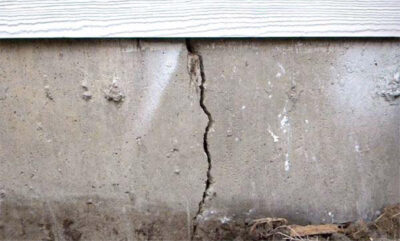 Some symptoms point strongly toward foundation movement; others can have multiple causes—the point is to document patterns and decide whether monitoring or repair is appropriate.
- Interior drywall cracking: jagged cracks, especially ~45° paths from corners of doors/windows, can indicate movement/stress transfer (not every drywall crack is structural).
- Doors/windows sticking, racking, or gaps: when multiple openings change together over time, foundation movement should be on the checklist.
- Sloped or cracked floors: unevenness across a room (not a single tile pop) can correlate with settlement/heave patterns—worth measuring and comparing over time.
- Basement/crawl moisture with crack staining: seepage, efflorescence, or rust staining near cracks can indicate active water paths—often relevant to how cracks should be treated.
- Bowed or leaning basement walls: can be associated with lateral soil/water loading—evaluate promptly.
- Garage slab / concrete cracks + chimney separation: can be clues depending on pattern, age, and progression—don’t ignore widening or new connectivity between cracks.
Pattern vs urgency: if you’re trying to judge “active vs stable,” start with our guide on active vs dormant foundation cracks.
Risks of delaying foundation crack evaluation (what gets worse over time)
Not every crack becomes an emergency quickly—but delaying evaluation can allow moisture and movement mechanisms to progress while symptoms are still “manageable.”
- Water intrusion + interior damage: cracks can admit seepage that damages finishes, framing, and stored belongings—especially during Puget Sound wet-season cycles.
- Concrete deterioration: chronic moisture can contribute to spalling and embedded steel corrosion over time (severity depends on exposure and crack behavior).
- Structural performance: progressive widening, racking, or changing crack patterns can indicate ongoing movement that becomes more expensive to remediate.
- Resale friction: buyers and inspectors often flag foundation symptoms; documentation and a clear repair rationale reduce uncertainty.
- Indoor environment (when moisture is present): damp foundation conditions can contribute to mold-friendly environments; people with respiratory sensitivities may notice symptoms more—this is context-dependent, not a universal “health guarantee.”
Foundations in the Puget Sound region face distinct moisture and soil-behavior stresses, from tree root–related moisture changes to reinforcement corrosion and concrete spalling when water paths persist. If cracking is part of a bigger settlement/movement picture, we route complex cases into our Structural Crack & Settlement Solutions library so recommendations stay coherent.
Foundation crack repair services (what we actually do in Everett & Snohomish County)
If you’re seeing cracking with leakage, widening patterns, or movement symptoms, the right move is an inspection-first plan—then repairs matched to the crack type and the goal (stop water, restore bond where appropriate, stabilize movement when present).
Basement Expert performs foundation crack repairs across Everett, Snohomish County, and the Puget Sound as part of a broader structural and water-management practice—when the scope extends beyond localized crack treatment, we align recommendations with our foundation repair hub so you’re not getting conflicting guidance.
- Exterior crack repair (when appropriate): exposure/cleaning, crack treatment appropriate to the assembly, and water-management detailing coordinated with drainage/discharge when hydrostatic loading is part of the problem.
- Interior stabilization / support work (when appropriate): when exterior methods aren’t sufficient—or aren’t the right primary path—we specify interior support/stabilization options based on observed movement and engineering judgment.
How much does foundation crack repair cost in the Everett area?
Crack repair pricing depends on access, crack pattern, whether the goal is water control vs structural bonding, and whether stabilization (not just injection) is required. Because of that, the only accurate quote is site-specific after inspection.
That said, many localized basement wall/slab crack repairs we see around Everett and Snohomish County often fall roughly in the $650–$2,650 range depending on access, crack behavior, and scope—but your project may be lower or higher. Estimates are written after inspection.
We focus on clear written scopes (what we’re doing and why), not marketing guarantees.
Schedule an inspection for a written estimate
When cracks need injection-based intervention, the method should match the goal—often choosing between epoxy vs polyurethane crack injection depending on whether you’re prioritizing structural bonding vs active water intrusion control. Ignoring coupled moisture/movement issues can increase long-term costs—see risks of ignoring foundation leaks. If you’re selling, documentation matters: selling a home with foundation repairs explains why professional documentation often reduces buyer friction compared to “mystery cracks.”
On this page we’re focused on Everett and Snohomish County crack diagnostics and repairs. For similar inspection-first framing in denser urban soils, see foundation crack repair in Seattle—same process discipline, different primary geography.
Foundation crack repair in Everett — FAQs
If you’re like most homeowners, you’re trying to figure out urgency, the right repair approach, and what drives cost. These are the questions we hear most often during inspections.
Can foundation cracks lead to bigger structural problems if they’re ignored?
Sometimes yes—cracks are often symptoms of movement, moisture pathways, or load paths changing over time. A crack may remain stable for a period, then accelerate after drainage shifts, seasonal swelling/shrinkage, or progressive wall loading. That’s why we prioritize pattern + progression: widening cracks, new linkage between cracks, racking openings, or active leakage usually warrants engineering‑mindful repair planning—not “wait and hope.”
When should I call a professional for foundation cracks?
Call promptly if you see active leakage, rapid widening, horizontal or stair‑step patterns that appear suddenly, bowing/tilting walls, or multiple openings sticking/racking at once. If it looks minor but you’re unsure, an inspection helps categorize active vs dormant behavior and sets a monitoring vs repair decision.
What repair methods do you use for foundation cracks?
It depends on the crack mechanism and goal:
- Injection approaches: epoxy vs polyurethane injection depending on structural bonding vs water‑stopping priorities.
- Movement‑related cracking: stabilization strategies when walls are progressively moving (may extend beyond injection-only scopes).
- Moisture drivers: drainage/discharge improvements when hydrostatic loading is part of the crack mechanism.
We don’t sell “one technique for everything”—we match method to what the inspection proves.
Are DIY crack repairs ever okay?
Hairline, dry, stable cosmetic cracks sometimes only need monitoring and finishing repairs—but “hairline” is easy to misread from the interior. If there’s water, widening, displacement, or movement symptoms, DIY injection/sealant jobs frequently mask drivers while deterioration continues.
What’s the risk of a DIY misdiagnosis?
The biggest risk is spending money on the wrong repair class (sealant/injection that doesn’t match movement/water behavior), delaying proper stabilization, or trapping moisture behind repairs that fail quietly. For leakage coupled with cracks, also understand why ignoring moisture pathways tends to increase total cost over time.
Service area (Everett & Snohomish County crack repairs)
We provide foundation crack diagnostics and repairs throughout Everett, adjacent Snohomish County communities, and connecting Puget Sound areas—especially where basement moisture and seasonal soil movement patterns drive cracking.
Related crack repair pages
- Seattle / King County crack repairs: Foundation crack repair (Seattle)
- Broader stabilization beyond localized cracking: foundation repair hub
We commonly serve Everett-area ZIP codes—confirm coverage when you schedule: (98201, 98203, 98204, 98207, 98208, 98213, plus adjacent Snohomish County communities). USPS routing can vary by exact address; downtown Everett also uses specialized postal designations such as 98206—confirm what applies to your property when booking.

